Assistance and guidance on a DSP file for a portable speaker project
Hi Everyone,
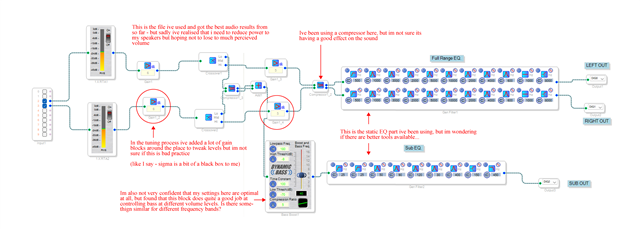
I'm working on a tuning setup for a small compact, battery powered Bluetooth speaker I am working on as a project, which utilises the ADAU1701JSTZ to tune sound of a 3 inch sub and two 1.5 inch tweeters (for L and R stereo). I've been getting some decent results but as a novice in the field of audio dsp tuning and theory in general, I was hoping to get some advice from folks here on how I can improve my audio quality further.
I appreciate this is hard to evaluate precisely at all (as so much depends on the enclosure, drivers, design), however I was hoping to get some idea of if best practices are being followed in my setup and more specifically:
1. How to reduce power consumption overall without compromising on volume and bass too much (currently, I'm overdriving my speaker with this configuration). I was hoping there might be a way to do this using some more intelligent form of compression, where I can keep the bass punchy and loud while driving my speaker less hard, power wise. Ive attempted this using a basic compressor block but found the results to be quite bad
2. To achieve a dynamic EQ across the frequency range. I'm using the bass booster block to stop my bass from clipping without too much noticeable compression, but feel like something similar (a dynamic EQ of some kind?) is needed to bring out the 400-800HZ range more and make it feel more full. Does a block exist that is an equivalent for highs? (so far, I am just applying a static EQ as you can see in the file - but find that its hard to get a good tuning for all types of music). I've been wondering if some means of dynamically adjusting the EQ for the higher frequencies based on amplitude or similar is feasible
3. Crossover advice - right now for such a speaker configuration I'm not fully comfortable in the crossover settings I have, and looking for advice there to achieve a rounder, fuller sound.
Any advice or help would be greatly appreciated!
Thanks, Reference DSP settings.dspproj
Hello Brs,
You have asked enough questions to fill up a text book.
I am going to attach a few projects to show a few examples.
This first one shows how you can protect the outputs by using a peak limiter to prevent the output from clipping the serial port output.
However, this limits the audio from clipping while in the DSP in a digital form. The assumption is that once the DAC converts it to analog and sends it to an amplifier the amplifier will be able to reproduce that level of signal without clipping. You can fix this in the analog world by setting the gain of the analog circuits properly. You could also lower the setting of the peak limiter to prevent the amp from clipping but that is not the best gain structure to use.
4643.ADAU1701 Crossover 2-way with 2-band Limiting.dspproj
This next project was taken from a Dayton Audio example project for their four channel amplifier board that has an ADAU1701 on it. I had presented a workshop at a conference using this program and talked about several things I did in this program.
This is a bit advanced but you can see how I did the EQ is using a much better and easier to see parametric EQ. I also implemented a way to do a loudness control where you have control over how it exactly works and you can also use that same feature to monitor the battery level and reduce the low end as the battery gets drained to squeeze out a bit more battery life.
There is a lot to unravel in here and it is tough for me to take the time to explain every little bit. It is great you are here on the forum. There is tons of posts with plenty of examples using the 1701 on the forum.
Also, I have to say that there are always several ways to do the same thing using SigmaStudio. You could use a compressor with an external sidechain input that has an EQ attached where you boost the low end going to the sidechain. This will cause the compressor to compress more if there is a lot of low end.
There is a lot you can do and some of this is audio theory and goes back to analog audio design techniques.
Dave T
Stereo 2-way Speaker Project.dspproj
Please log in to reply.