graphic wave and frequency response
Hello everyone I am PaBLo8@.
I'm not good with English so I am using a translator, I hope you understand me.
I'm doing my thesis on audio, and I found the "MINI BOARD EVAL AD1940 SigmaDSP". So I'm looking at all the information gathering and examples.
So I'm starting with the basics and want to do the following but not as:
As is the block diagram to observe in a graph (amplitude vs. time) is a waveform diagram senoidal.También as to observe block a graph (amplitude vs. frequency) the same sine wave.
And the same with the following signs:
Triangular-wave
Sawtooth-wave
Pulse-Wave
Meeting all the blocks I need, but do not know how to connect and display graphs above.
Please if you can help me, I would be very grateful.
See you soon.
ad1940
Audio Signal Processors
SigmaDSP Audio Processors
Hola Pablo:
Si quieres poner to pregunta en espaniol, tambien te podemos ayudar. Desafortunadament, el SigmaDSP (al menos la 1ra y 2nda generacion) no tienen como calcular una transformada de fourier y desplegarla en pantalla. El procesador es un procesador the muestras continuas y no de procesamiento de bloques. Podrias usar un banco de filtros si quisieras desplegar el valor de varias frecuencias pero esto no es muy optimo y las frecuencias van a interactuar con frecuencias anexas..
Espero que esto funcione, saludos
Hi Pablo:
Unfortunately the current generation of SigmaDSP cannot efficiently calculate an FFT and therefore displaying the different frequencies of those waveforms will need to be done with a filterback if needed. The sigmaDSP is a stream oriented processor and cannot do block processing (at least the first 2 genation of SigmaDSPs). Using a filterbank will show cross frequency bleeding and a non optimized way of performing this.
Hope this helps
Miguel
Hi Pablo,
It looks like you desire to measure and graph the frequency spectrum of several harmonic-rich waveforms. In DSP this is usually done by FFT (Fast Fourier Transform), a frequency-domain technique. Unfortunately, SigmaDSP is not well-suited for frequency-domain work. Please see this post for more info:
https://ez.analog.com/docs/DOC-1671
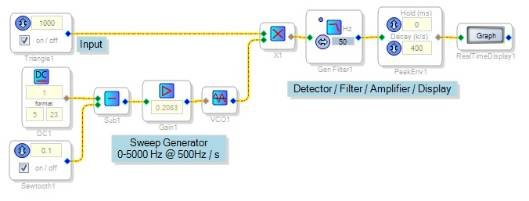
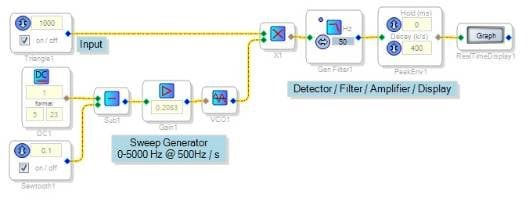
That being said, SigmaDSP does a wonderful job making good old analog techniques look easy. If you're familiar with the old spectrum analyzers for radio, you know they work like a sweep-tuned receiver with a display. An example circuit in SigmaStudio might look like what's shown below:
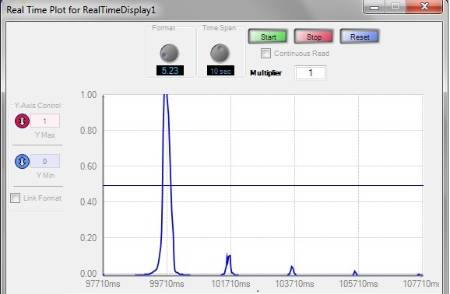
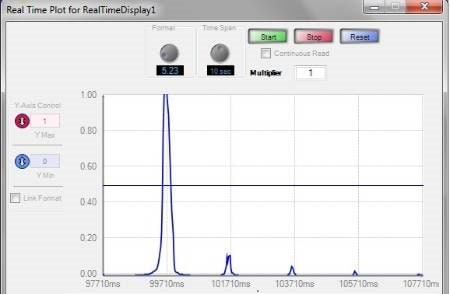
The input triangle wave is multiplied by the output of a sweep generator (made from a sawtooth gen and a VCO). The multiplier output has the sum and difference frequencies, we filter out all but the smallest difference frequency (including DC). As the sweep generator ramps up from 0 to 5000 hertz, it "finds" the fundamental and harmonics of the input triangle wave. The result is shown on the RealTimeDisplay below:
The RealTimeDisplay is running at two seconds per horizontal division -- with the sweep generator doing 500Hz per second, that means 1KHz/division. Thus the harmonics are spaced one division, or 1000Hz apart. The vertical axis is in "volts" (actually just a decimal number, this is DSP after all). Both axes are linear (not log frequency and not dB). Another limitation of this technique, familiar with anyone who has used a RF spectrum analyzer, is that it takes time to sweep through the frequency range (Fast, it isn't).
By the way, the AD1940 board is great for experimenting with what SigmaDSP can do. Most engineers start out with the ADAU1701 board, which is an excellent choice when the goal is to design hardware using -1701s. The main advantage of the -1701 over other SigmaDSPs is its built-in converters, allowing analog-in, analog-out convenience which makes designing with them a bit easier. But if you're more interested in seeing what SigmaDSP can do, the mini-1940 board costs the same and does more (with six inputs, higher instruction count, way more delay, and more ADI algorithms available). Welcome to the SigmaDSP world, there's lots of good stuff in here.
Best regards,
Bob
Thanks for sharing that technique, Bob. That's really cool!
Muchas gracias por sus respuestas.
Ya se que no puedo obtener las respuesta en frecuencia de una onda sonoidal. ¿Se puede obtener el gráfico en el tiempo de una onda senoidal. Si hay como, como lo hago. Y también para una onda triangular, diente de sierra y para un tren de pulso?
Hasta pronto.
Hola Pablo.
La respuesta de Bob (arriba) menciona como puedes hacer esto con los bloques disponibles de SigmaStudio para SigmaDSP.
El grafico esta generado en tiempo real, pero toma algo de tiempo en ser generado. Mi recomndacion es que uses un 1701 y simplemente cambies el generador de: onda senoidal a pulso, triangular, diente de sierrra....
Saludos
Miguel
Hi Pablo:
The answer Bob provided (above) shows how to do what you are trying to do with available SigmaStudio blocks for SigmaDSP. The graphic and display is generated in real time but it takes some time to get generated. Mi advice is that you use the 1701 and simply change the generated input wave from: sine wave to triangular, sawtooth....
Hi Miguel,
Thanks for the help with this answer and with the Spanish. My high school recommended French or German for those interested in engineering. They were off by only about 50 years! I forgot all my French and wished I had taken Spanish, which is far more useful in the Americas.
Bob
Muy buenas amigos, gracias por sus respuestas. Estoy haciendo mi proyecto de titulacion sobre filtros digitales para implementar un audifono digital para corregir las deficiencias en ciertas frecuencias.Y necesito saber cual es la placa de ultima generacion, caracteristicas tecnicas, manual de usuario, precios y donde y como la puedo conseguir. por favor si me pueden ayudar. Ademas mi tutor de tesis realiza investigaciones para solucionar discapacidades auditivas y esta muy interesado en estas placas, por favor si me ayudan
gracias!
Very good friends, thank you for your answers. I am doing my project on digital filters titration to implement a digital hearing aid to correct deficiencies in certain frecuencias.Y need to know the plate last generation, technical characteristics, user manual, prices and where and how I can get. please if you can help me. My thesis advisor also conducts research to solve hearing and is very interested in these plates, please if you help me
thank you!
This question has been assumed as answered either offline via email or with a multi-part answer. This question has now been closed out. If you have an inquiry related to this topic please post a new question in the applicable product forum.
Thank you,
EZ Admin
Please log in to reply.