Modifying SigmaDSP's EEPROM content using a uController
Hello!
I'm developing an application that uses ADAU1701 along with it's own eeprom, pretty much the same schematic as ADAU1701 MINI evaluation board.
I'd like to use a microcontroller with the least amount of memory possible, therefore ADAU1701 will boot from its own EEPROM. That's fine, but the question is, can I update this eeprom with parameters like coefficients etc? In SigmaStudio, the capture window shows addresses for the DSP's memory, but in that case I would need eeprom's addresses too, so I can update parameters "for good", have the equipment shut down and next time it powers up it will boot from the eeprom containing program AND the parameters saved last time the equipment has been used. Is that possible? In case it is, how can I find the addresses for eeprom locations that corresponds to the DSP's registers (coefficients, selections, etc)?
Thanks!!!
Audio Signal Processors
SigmaDSP Audio Processors
adau1701
Hi again!
I reading more carefully the datasheet, I figured that it would be best to use the writeback function instead. Good, except that I can't make it work!
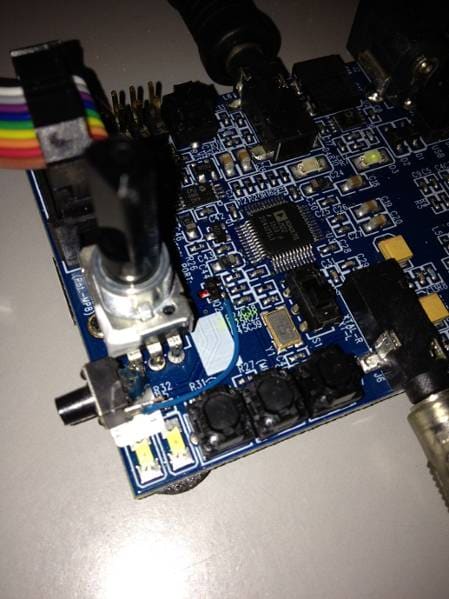
Well, the evaluation board has a trigger transistor that triggers WB on the absence of voltage, however it doesn't seem to work. So, instead of "hoping it will have enough time to writeback" after power source is removed, I made a small modification on the board, see the photo. The switch pulls down base of the trigger transistor, so WB pin goes high. I already checked and it is working electrically speaking,WB pin really goes high. Also, S5 is on the down position, so I'm sure that EEPROM's WP is disabled.
My test is very simple: I have an IIR filter on my program and I wrote the last compilation to the EEPROM, so when I push reset, it self boots just fine along with the parameters set when I last compiled the program. So that's working. Then, I change a configuration, let's say I change a 1khz HPF filter to LPF, so I can hear the difference. I trigger WB, by pushing the additional switch (and I already tried removing the power too), so I expect that on reset (or next power up) the modification made (from HPF to LPF) will still be present (LPF), however it just goes back to the configuration set before I first wrote compilation to the EEPROM (HPF).
Any ideas?
Thanks!!
Hello,
I have a different approach in mind:
Let the SigmaDSP boot-up from the EEPROM, normally. After the boot process is complete, update all the user accessible parameters from the micro-controller directly to the SigmaDSP. So at any given time, the boot image remains original/ intact.
In other words, the job of restoring/ memorizing the LAST user accessible parameters is done by the microcontroller.
Kindly let me know your thoughts on this.
I think that's necessary, because reading AN-923 I found that only 35 bytes can be written back, that's not enough for 16 IIR filters that I have. The tradeoff is that my uController must have more memory than I antecipated... Is there any other way around this?
I just want to make sure i'm not getting ahead of myself: Writeback can only write up to 35 bytes, so it's just not enough to store many iir filter coefficients. That being said, the uController must keep these coefficients saved instead, but, my uController does't have enough memory for that. Is there anyway that the uController could perform writes to BOTH sigma dsp AND the boot eeprom every time a new filter coefficient is sent?? That way I would always keep the boot eeprom up to date so I won't need extra memory or wb. Is that possible?
Thanks.
Or boot from micro-controller and completely eliminate the EEPROM.
Updating the filter parameters is not a good idea using a micro-controller. You have to do it using SigmaStudio and freeze it there. Else, wait till AD releases GUI builder.
Booting from the uController is not an option because it doesn't have enough memory to hold thr program. I can update the filter coefficients using the microcontroller without any problems, only care must be taken is to use the safeload registers or mute the audio during the process. So I get back to my original question: Is it possible to write to both dsp and boot eeprom, via uController, every time a new coefficient is sent?
Another question: Can I have two DSPs on the same I2C bus (with different addresses) booting from the same eeprom?
There is a little bit of work required to get the interface write/read function to work. I wrote a detailed guide here:
How do I use the Interface Read / Interface Write and Write-Back Trigger?
Jerad wrote an application note about using the ADAU1701 in self-boot mode (and also accessing the chip's control port at run-time) here:
Designing a System Using the ADAU1701/ADAU1702 in Self-Boot Mode
You can certainly self-boot the system and then have the uC write to both the SigmaDSP and the EEPROM at run-time, but that has a few requirements:
Both the SigmaDSP and the EEPROM must be on the same I2C bus
You need to know the exact locations of all of the parameters in the EEPROM. SigmaStudio will not provide this for you, because it is dependent on the EEPROM image. You'll need to manually open the EEPROM image and search for the exact locations of each parameter you need to update. You also need to consider that EEPROMs often need to be written a page at a time, so in order to update a few bytes, the uC would have to do some tricky data manipulation to be able to write the correct data to the page. As far as I know, nobody has attempted this before.
Lastly, it might not be possible to boot two SigmaDSPs from the same EEPROM, as far as I can tell. I certainly have never tried it. My reasoning is as follows: since the SigmaDSP has to be a master on the I2C bus during the self-boot, and the EEPROM is a slave, you would have bus contention if both SigmaDSPs were trying to be masters at the same time.
Please log in to reply.